Before You Sign a Philadelphia Lease, Run This Free Search
How 4philly.net turns three scattered city systems into one landlord check — no account, no login, nothing stored
Philadelphia keeps good records. L&I logs every violation. The city's open data portal tracks every rental license. Philly311 catalogs every complaint. The problem isn't that the data doesn't exist — it's that it lives in three different systems, indexed three different ways, and none of them are built for someone standing outside an apartment trying to decide whether to sign a lease.
4philly.net is a free tool built to close that gap. One address in, a real answer out.
What Is 4PHILLY?
Philadelphia's rental records are public. They just aren't easy to read.
4PHILLY is an independent tool that checks public landlord and property records before you sign a lease — pulling L&I violations, 311 complaints, and rental license status out of the city's open data and putting them on one page.
- Free
- No account required
- No login
- Nothing stored on the server
What City Records Does It Actually Pull?
4PHILLY reads directly from Philadelphia's open data:
- L&I violations — home, license, and every inspection history
- Rental licenses — current status, active or expired, and expiration date
- 311 complaints — the public complaint feed, tied to the address
- Permits — building permits filed against the parcel
- Building certifications — tied to the property record
All of it routes through the parcel's OPA account number — so records stay tied to the exact parcel, not an ambiguous street address that might match three different buildings on the block.
How Does It Join Three City Systems Together?
Philadelphia runs L&I violations and licenses, property records, and 311 complaints as three separate systems that don't talk to each other. 4PHILLY is the join.
| System | What it's for |
|---|---|
| Property Lookup | Enter the address or OPA account number to get the OPA account, Licenses & Inspections status, and open violations |
| Atlas | Search the address for a permit or inspection history, or use a case number to check status |
| Philly311 direct | Pull the public complaint feed directly for the address |
Instead of searching Atlas for the parcel, L&I for licenses and violations, and Philly311 for the complaint history separately, 4PHILLY joins them for you — matched by the same address pattern, so nothing gets missed in translation.
Why Does the OPA Number Matter So Much?
It's Philadelphia's unique parcel ID. One street address can cover multiple parcels, so the address alone is ambiguous — the OPA number isn't.
Violations, licenses, permits, and certifications all run on separate city systems, so what ties those separate systems together is one thing: they're all matched by OPA number. 311 complaints are the exception — they're matched by address pattern, which can occasionally miss a match.
Can I Use This to Push Back on a Landlord?
That's the point.
- The landlord — open records of expired licenses and borrowed history, not just their word
- A housing attorney — walk in with the citation history and license number already pulled
- Your council member — a documented complaint pattern makes a constituent complaint actionable
Where it stops: 4PHILLY can't certify anything. For a court or a lawyer, verified records come from L&I, and the known material is general information — not legal advice.
What If My Landlord Is Unlicensed?
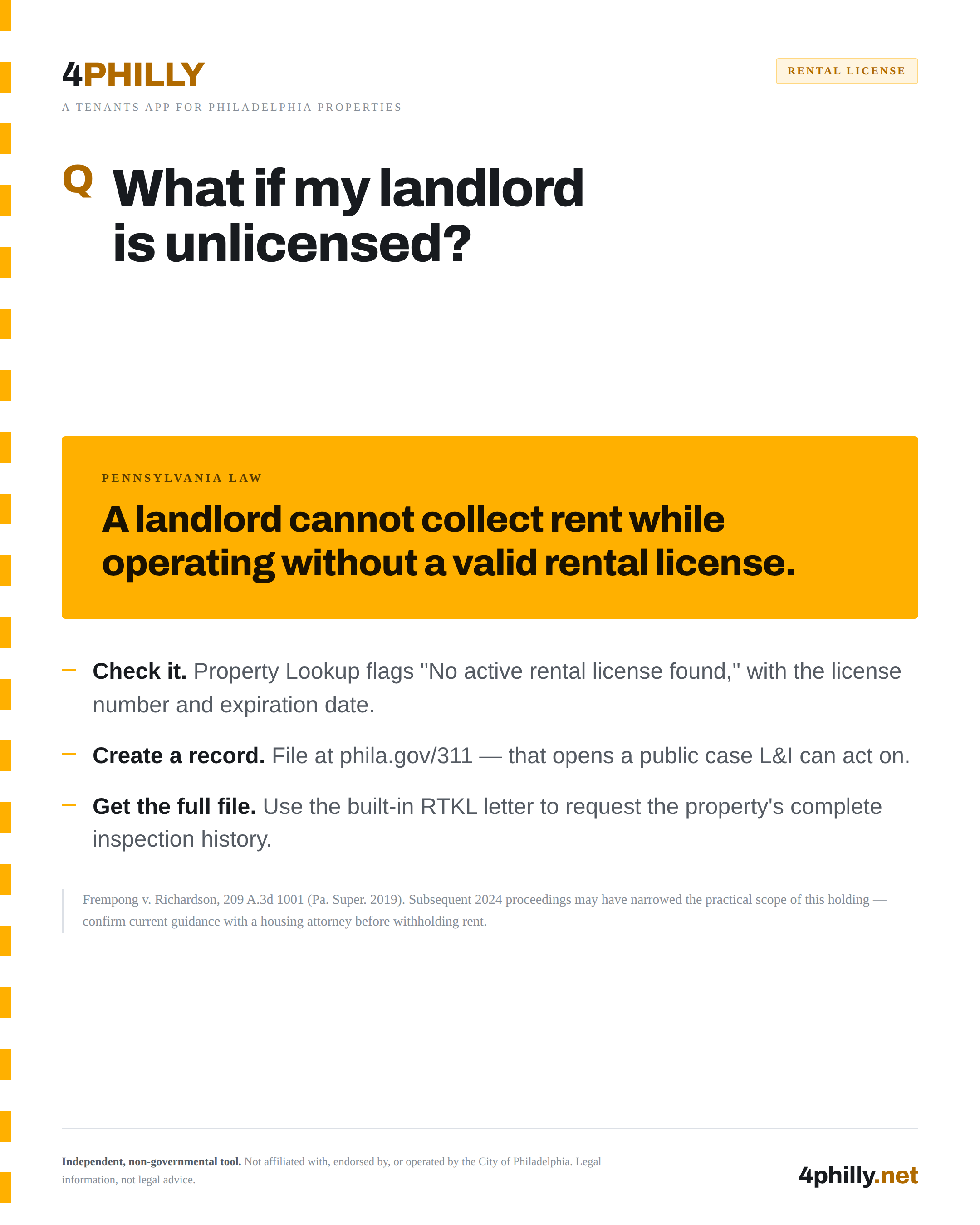
A landlord cannot legally collect rent while operating without a valid rental license in Philadelphia.
- Check it. Property Lookup flags "No active rental license found" with the license number and expiration date.
- Create a record. File at phila.gov/311 — that gives you a public case number you can cite.
- Get the full file. Use the Right-to-Know request page to request the complete inspection history.
For the full picture — including what Phila. Code § 9-3902 says about rent collection and eviction while unlicensed — see your rights when a landlord is unlicensed and how to check a rental license.
Can Landlords See What I Look Up?
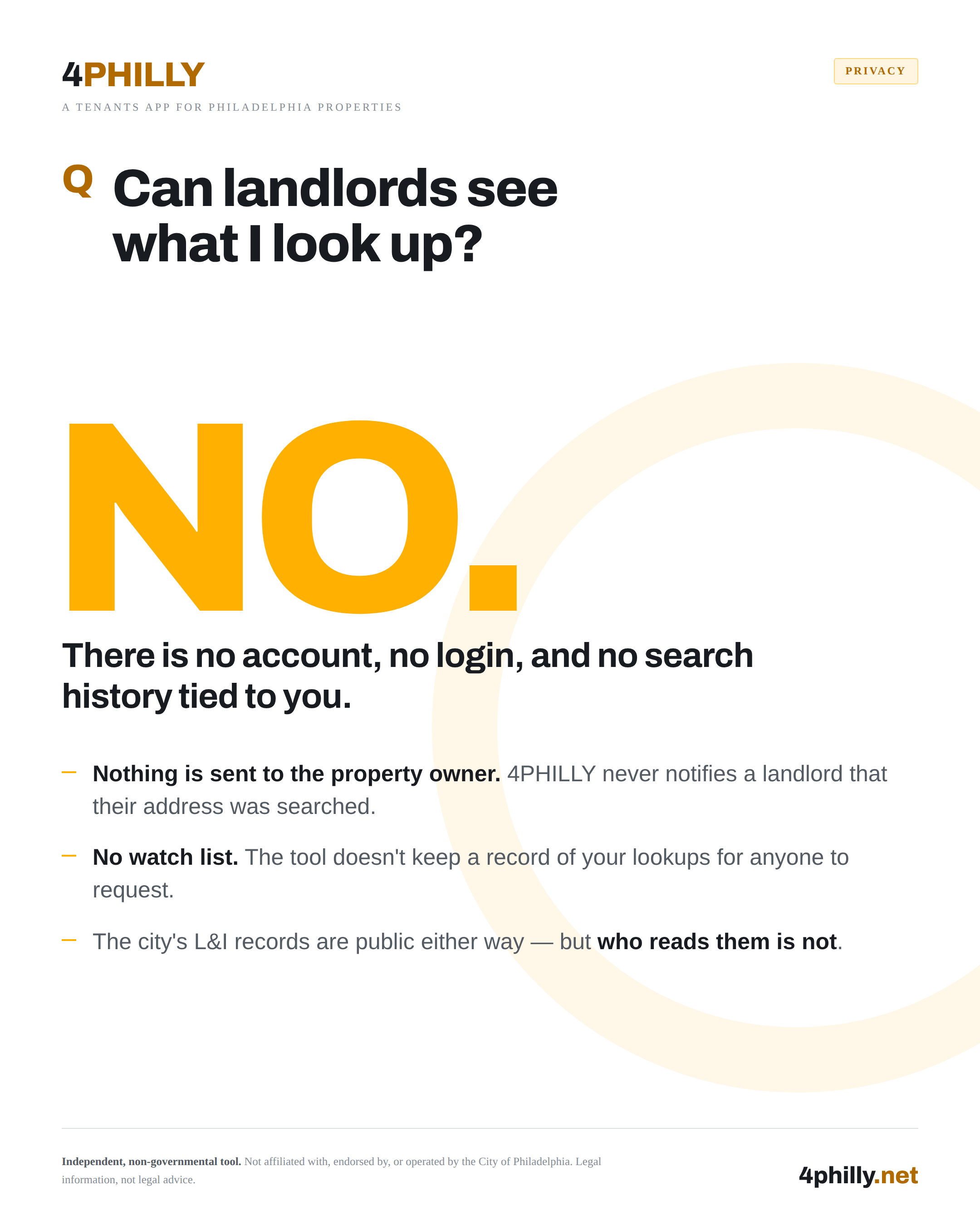
No. By design.
There is no account, no login, and no search history shown to you or anyone else. Nothing is sent to the property owner — 4PHILLY never notifies a landlord that their address was searched. There's no watch list either. The operator keeps a private log of what is typed into the main search box, used only to confirm the tool is used and to detect abuse; it is not shared or sold.
The city's L&I records are public either way — but who reads them isn't.
Can Anyone See Who Filed a 311 Complaint?
No. By design.
The public Philly311 feed shows the complaint and its timing — never who filed it. That anonymization is deliberate: it protects a tenant from retaliation for reporting, and retaliation is illegal under the PA Landlord Tenant Act, § 5720, regardless.
How Accurate Is the Violation Data?
L&I's live, authoritative backend is li.phila.gov. Philadelphia's open data mirror is Carto — public open-data mirror, can lag days to weeks behind.
COMPLIED is currently uncontested. OPEN is unresolved as recorded. Administrative closure with no recorded compliance still shows as COMPLIED — administrative counts as compliance.
What Does COMPLIED Actually Mean?
Compliance was recorded in the system.
That's not the same as an inspector physically re-visiting the address — compliance can be closed administratively, so it isn't a definitive proof the issue was actually fixed.
To verify what you found:
- Atlas — look up the OPA account number and confirm boundaries; one street address can cover multiple parcels.
- L&I / Eclipse — search the OPA number to open violations, license status, permits, and certifications not visible in Carto. This is the authoritative record for any lease or legal action.
- Philly311 — review the raw, unedited complaint feed for the address over 12–24 months, and see which were closed and which are still open.
Can I Trust the 4P Score?
Treat it as triage. Not a verdict.
It's a 0–100 summary score, built from three public data points and nothing else:
- It is not an inspection, and not a safety rating or judgment about any person.
- A landlord operating through multiple LLCs can undercut the owner-level picture.
Use it to sort a list of addresses fast — then confirm anything that matters with the live L&I record before you rely on it.
Can I Use 4PHILLY Records in Court?
- Screenshots are not certified evidence. 4PHILLY isn't a government record and can't certify anything.
- The underlying records are real and public. Full copies come straight from L&I.
- If you need certified copies, use 4PHILLY to identify which records to request, then file a Right-to-Know Law (RTKL) request through L&I's Open Records Officer for certified copies — the Right-to-Know request page fills in the official form for you.
Research and prepare with 4PHILLY. File with certified copies from the city.
Atlas or 4PHILLY — Which One Do I Use?
| Atlas | 4PHILLY | |
|---|---|---|
| Reads from | The free Eclipse record — licenses, inspections, violations | Scans what Carto delayed; the Eclipse read is definitive |
| Also has | Mapping, zoning, and permits beyond a property lookup | 4P Score and open permits in a click |
| Best for | Zoning research | The definitive source for a filing |
Atlas when you need the record to hold up. 4PHILLY when you need the read, fast.
What Data Does 4PHILLY Collect About Me?
No account. No login. No profile. A private operator log of main-page searches exists to detect abuse; it is never shared or sold. Google Analytics and ads on the main page and blog are covered in the privacy policy; the Right-to-Know page has neither.
- Never asked, never retained: your name, mobile info.
- Anything you type into the 311 template or the Right-to-Know form stays yours — you fill it in, you send it, it isn't sent to or logged on the server.
Can It Write My RTKL Request for Me?
Yes — pre-filled.
- Pulls the address, OPA number, and case numbers straight from the record you're looking at.
- Fills in the official Pennsylvania Office of Open Records request form — the same form the state publishes — and gives you the PDF.
- Edit what you're asking for, then send it to L&I's Open Records Officer yourself.
- Runs on your device; nothing you type into the form is sent anywhere or logged.
This is how you reach an inspector's notes and site photos, which are never public on their own.
Make a Right-to-Know request → · Blank official form (PA Office of Open Records)
Which Source Do I Trust for a Lease Decision?
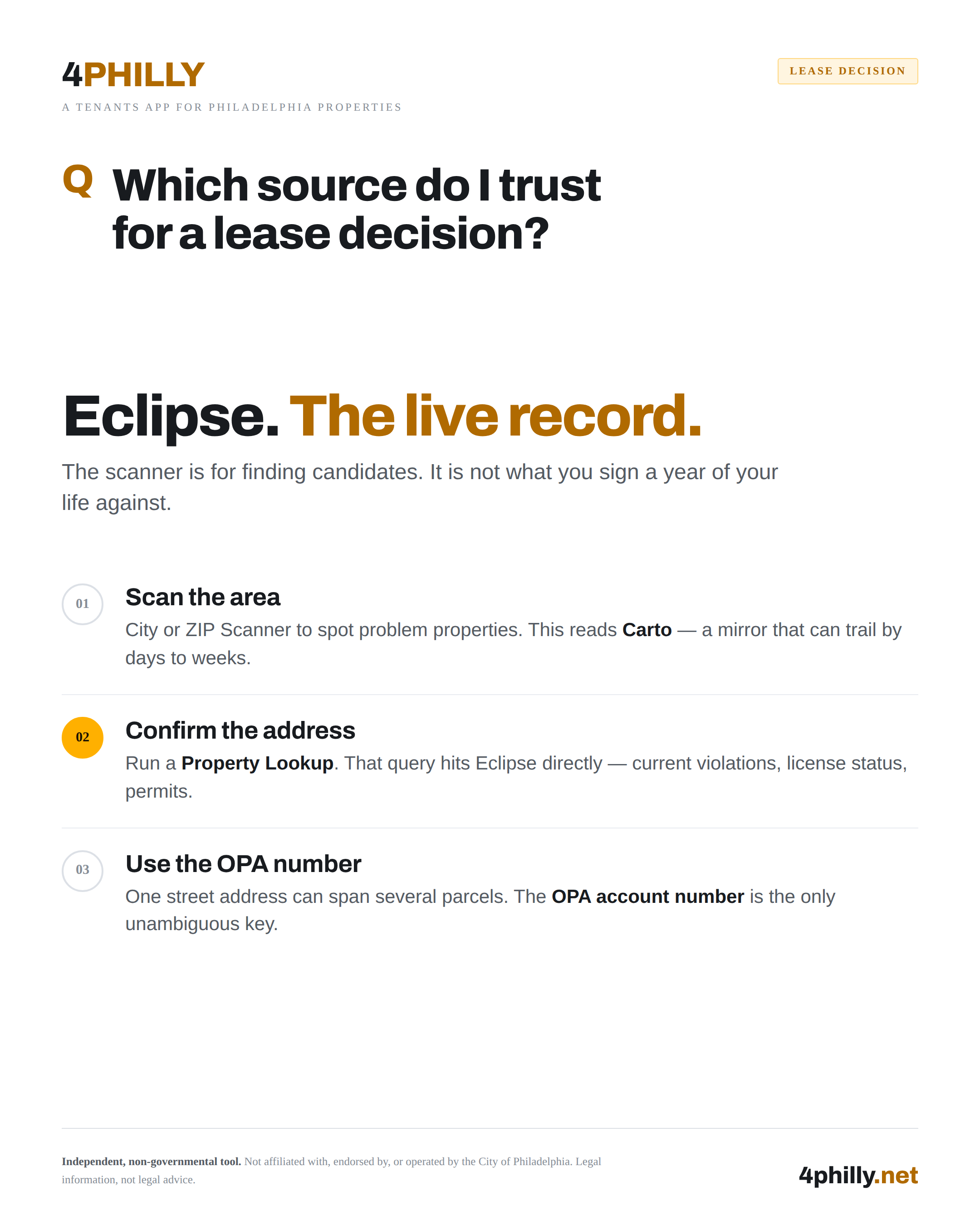
Eclipse. The live record.
The screener is for finding candidates. It is not what you sign a year of your life against.
- Scan the area — City or ZIP scanner to spot problem overview. This reads Carto — a mirror that can lag days to weeks.
- Confirm the address — run a Property Lookup that queries Eclipse directly: current violations, license status, permits.
- Use the OPA number — one street address can span several parcels. The OPA account number is the unambiguous key.
The Bottom Line
Philadelphia's rental data has always been public. The gap was never access — it was that checking a landlord meant three separate city systems, three separate learning curves, and enough time that most renters just skipped it.
4philly.net closes that gap: one search, three systems, an answer before you sign.